December 3, 2025
The Top 5 Challenges in Manual Clinical Data Abstraction (And How AI Can Fix Them)

Clinical data abstraction sits at the center of cardiovascular quality. Every ACC/NCDR, STS, or AHA Get With The Guidelines (GWTG) registry submission depends on clean, timely, and accurate data. The information collected is essential to measure performance, support structural heart programs, prepare for audits, and guide quality improvement initiatives.
Despite its value, manual abstraction remains one of the most difficult and resource-intensive functions within any cardiovascular service line. The work requires significant time, deep clinical knowledge, and the ability to track details buried in long, unstructured medical records. As registry requirements evolve and staff capacity fluctuates, it becomes harder for teams to keep up.
Recent advances in artificial intelligence now offer a more effective approach. Modern large language model-based systems (LLMs) can take on the most time-consuming parts of abstraction and support a more reliable and scalable quality program.
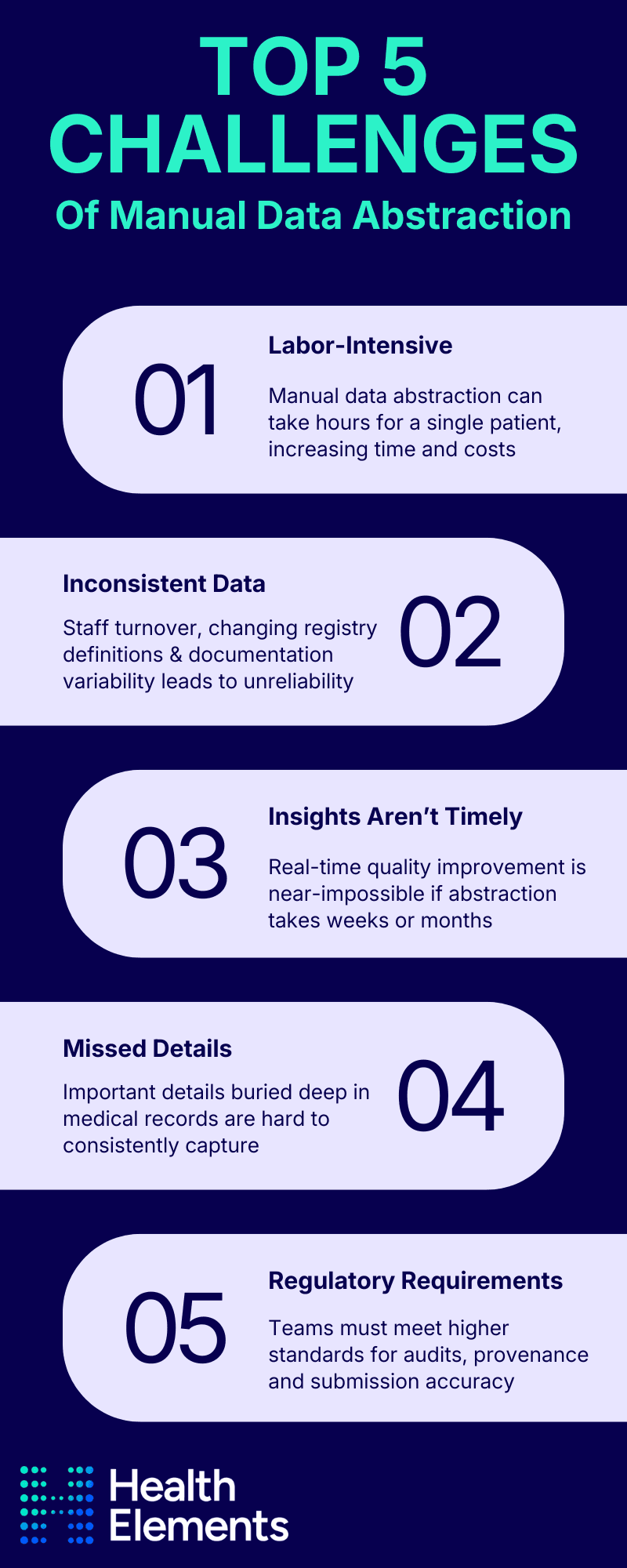
Below are the five most common challenges in manual abstraction and the ways AI can help address them.

Challenge #1:
It’s Labor Intensive and Hard to Scale
A complete cardiovascular chart can take hours to abstract. Multiply that by dozens or hundreds of cases per month, and the workload becomes overwhelming. Across a medium-sized health system, total abstraction spending can exceed $15M per year across all of their service lines. When experienced abstractors leave or positions sit open, delays get even worse.
The AI Solution
AI driven abstraction systems can extract diagnoses, procedures, outcomes, and registry specific variables much faster than manual review. Health Elements’ clients can expect to see abstraction time reduced by up to 90 percent, with total data abstraction costs falling by 50 percent or more.
The goal is not to eliminate human abstractors. Instead, AI handles repetitive, time-consuming tasks so registry teams can focus on activities that drive even more value for the health system: evaluating complex cases, rolling out quality initiatives, and clinical leadership. AI-based abstraction enables them to work closer to the top of their license.
Challenge #2:
Human Variability Leads to Inconsistent or Unreliable Data
Even well trained abstractors interpret documentation differently. This is especially common in cardiovascular care, where subtle findings in imaging reports or clinical notes can affect case classification.
Variability increases with staff turnover, changes in registry definitions, or inconsistent documentation patterns across providers.
The AI Solution
LLM-based abstraction provides consistent interpretation of medical records. Health Elements’ accuracy has been validated at 96.3 percent. Unlike older keyword-based NLP tools, modern clinical AI models understand the context of complete sentences and paragraphs, conflicting statements, and complex clinical nuance.
An optional human-in-the-loop (HITL) review allows abstractors to approve or adjust AI-generated answers. Every adjustment feeds the model, allowing it to learn site-specific documentation patterns. This combination of automation and professional oversight helps data stay consistent even as staff change.
Challenge #3:
Data Arrives Too Late for Meaningful Quality Improvement
By the time manual abstraction is finished, the data is often months old. This delay limits the ability to identify trends, intervene early, or support a true concurrent review process. It’s like trying to navigate by looking backwards rather than understanding what’s happening in real time.
The AI Solution
AI abstraction enables near real-time data availability. Cardiovascular service lines can shift from retrospective review to concurrent review, which allows teams to track quality issues while care is still in progress. This enables the team to identify problems sooner and prevent smaller quality issues from becoming bigger ones.
Health Elements includes real-time dashboards, prebuilt registry reports, and the ability to integrate data into existing systems such as PowerBI, Excel, Snowflake, or Databricks. This makes the data not only accurate but also immediately actionable for clinical leaders, so they can migrate from reactively reporting on quality to proactively improving it.
Challenge #4:
Critical Clinical Details Get Missed
Important information is frequently embedded deep within the medical record. Examples include valve measurements in echocardiography reports, risk factors noted only in clinic documentation, or comorbidities mentioned once in a consult note. Once errors exist in the record they are commonly copy-pasted for years or decades.
These details are easy to miss during manual abstraction, partly due to time constraints and partly because records vary widely in structure and clarity. Complex electronic health records can also be hundreds or even thousands of pages long. Busy clinical experts just don’t have time to read through everything. The mountain of data that has been created may be covering a deposit of gold… but it’s impossible to access with picks and shovels.
The AI Solution
AI systems can scan the entire medical record and surface clinically important findings, even when they appear in unexpected places. This is particularly valuable for cardiovascular care, where a single missed variable can significantly change a case.
Health Elements’ AI technology can help identify potential treatment opportunities, such as patients with under-treated aortic stenosis or incomplete workups. Research shows that up to 25 percent of AS diagnoses are missed during routine care, and a large share of severe symptomatic AS remains under-treated. AI helps prevent patients from falling through the cracks and gives clinicians a fuller picture of their population.
This same ability also strengthens comorbidity capture for more accurate risk adjustment and produces cleaner real-world data for research and post-market surveillance.
Challenge #5:
Audit and Regulatory Requirements Are Becoming More Complex
Cardiovascular registries require more than accurate data. Teams must document provenance, maintain audit trails, follow strict PHI handling standards, and map data to formats like FHIR, OMOP, and CDISC. As the regulatory environment evolves, so does the workload.
The AI Solution
Health Elements was built with regulatory readiness at its core. Key differentiators include:
Certified submission to ACC/NCDR, STS, and AHA GWTG
Complete provenance tracking for every data element
SOC 2 Type II aligned, HIPAA-compliant infrastructure
Human-in-the-loop workflows that provide transparency and defensibility
Support for FHIR, OMOP, and CDISC for smooth export and integration
For quality teams, this means less time wrestling with formatting, audits, or technical barriers — and more time improving care.
Moving Beyond The Challenges: A More Scalable Approach to Cardiovascular Quality
AI-supported clinical data abstraction is already reshaping how cardiovascular teams manage registry reporting, identifying under-treated patients, risk documentation, and real world data programs. It’s a practical way for cardiovascular teams to reduce costs, increase consistency, and access high-quality data much closer to real time.
What differentiates Health Elements is a combination you don’t often see together:
Deep registry expertise and direct submission capabilities
Clinical-grade AI models with proven accuracy
Full provenance and audit readiness
Real-time analytics
A human-centered workflow that keeps abstractors in control
The result is cleaner data, faster insights, and stronger support for physicians and quality leaders.